
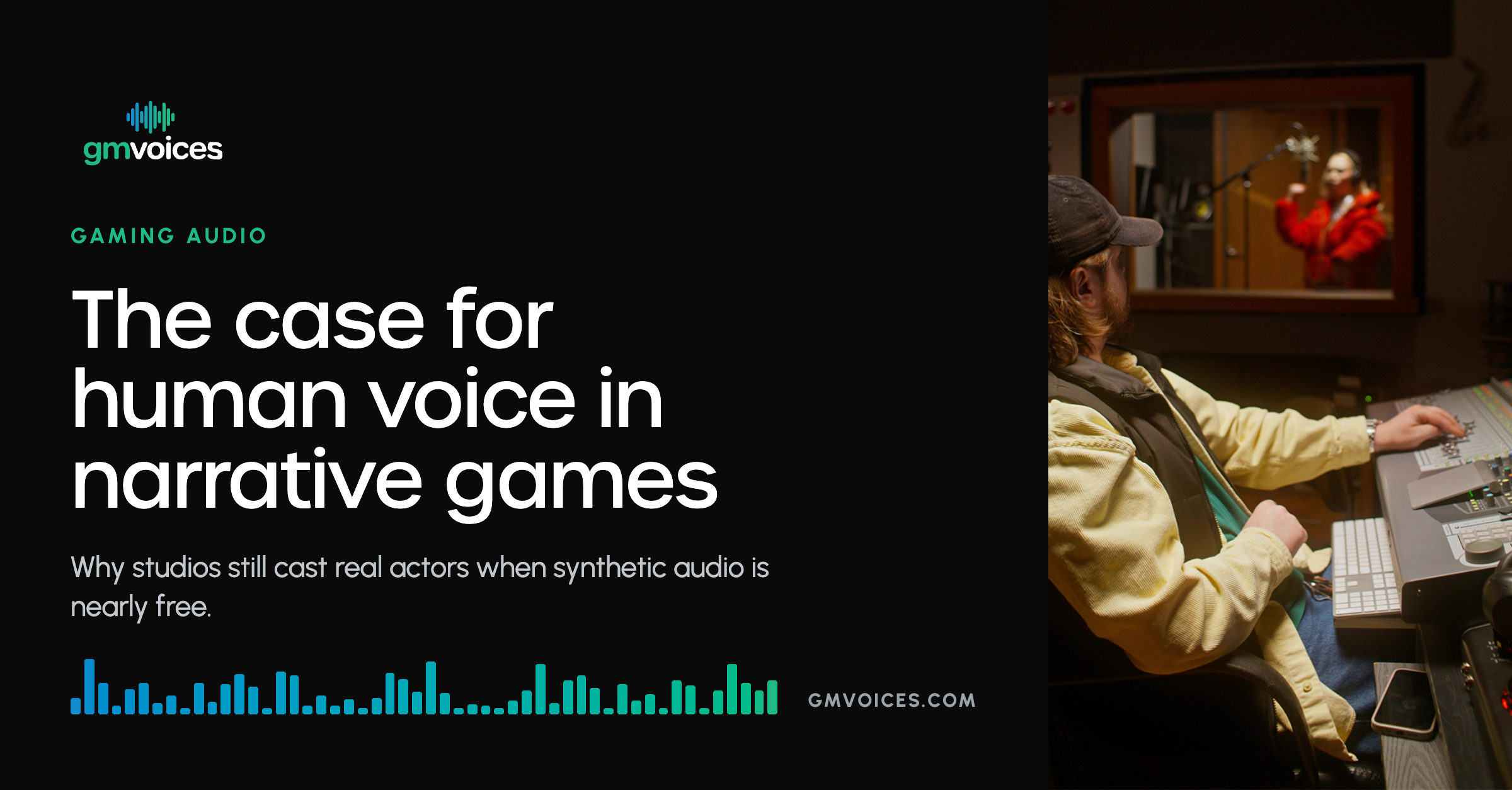
AI voice generation is the cheapest it has ever been. A studio can type a line, pick a synthetic voice, and have usable audio in seconds for a fraction of what a session with professional character voice actors costs. That math should have ended game voice acting as a profession by now, but it hasn’t.
Many studios shipping story-driven titles this year still have casting directors, session schedules, and human actors behind the mic. The studios with the most budget pressure and the most reason to cut corners are still paying for people.
These studios aren’t being sentimental, and they aren’t behind on AI. They understand that what they’re paying for was never just audio.
What Studios Are Actually Paying For
When a studio books a narrative game VO session, the file that comes out of the booth is just the end result. What the studio is really buying is a set of decisions that no script can fully specify: where the character’s voice breaks, how much anger sits underneath a line that reads as calm on the page, whether a confession lands as relief or defeat.
A synthetic voice can deliver a line, even several versions of it, but it can’t make a choice about it, and narrative work is built entirely on those choices. A single line like “I know” can carry grief, threat, resignation, or love depending on what the character has lived through by that point in the story. An actor makes that call in context, take after take, with a director shaping the read against everything the player has experienced up to that moment.
That loop between actor and director is the real engine of game voice acting. Direction lets a studio discover the character in the session, not just document a script. Some of the most memorable lines in gaming were found in the booth, improvised or reshaped when an actor understood the character better than the page did.
Players Remember Voices, Not Waveforms
There’s a commercial argument here too, and it’s the one studio leadership should care about most. Players attach to characters more than anything else in a game, and for most of a playthrough, the voice is the character. In a thirty-hour narrative game, the protagonist’s voice becomes one of the most familiar sounds in the player’s week.
That attachment is what drives sequel sales, merchandising, fan communities, and the decade-long franchise loyalty that turns a title into an IP. When players quote a game years later, they’re quoting a performance. They do the voice. A synthetic read can be clean and consistent and still leave nothing behind for the player to hold onto.
There’s also a trust dimension that studios ignore at their own risk. When players hear synthetic voices in character roles, they read it as a signal of how much the studio invested in the experience. Arc Raiders is a useful example precisely because it isn’t a narrative game. It’s a multiplayer extraction shooter, and its use of AI-generated dialogue still drew heavy criticism, with Eurogamer treating that decision as a central flaw in its two-star review. Embark later re-recorded some of those lines with professional actors, and its CEO acknowledged the quality difference plainly, describing AI as a production tool rather than a replacement for performers. That’s the same distinction this article is drawing, from a studio that learned it in public.
The concern goes beyond reviews. SAG-AFTRA filed an unfair labor practice charge against Llama Productions, the Epic Games subsidiary behind Fortnite, over its AI-generated Darth Vader voice, arguing the implementation replaced work previously performed by union actors without negotiation. Synthetic voice in character roles carries reputational and labor risk that has nothing to do with the cost of producing the audio.
Where AI Voice Actually Belongs in Game Development
To be clear, AI voice has a legitimate lane in a production pipeline, and studios that refuse to use it there are paying actor rates for lines that don’t need an actor.
AI voice earns its place in scratch and placeholder work, where designers need timing and pacing in a build long before final casting. It’s genuinely useful for prototyping dialogue systems, stress-testing localization line lengths, and filling temp audio so playtests don’t run on silent text boxes. For purely functional, non-narrative audio, like a menu confirmation or a tutorial system voice with no character attached, synthetic delivery is often the right call.
The real dividing line is narrative versus non-narrative, not human versus AI. The moment a voice is attached to a character the player is supposed to feel something about, you’ve crossed from a production task into a performance task, and performance tasks need performers. Studios that get this distinction right spend less overall, because they stop paying actors for utility lines and stop shipping synthetic reads in roles that carry the story.
How to Brief a Narrative VO Session So the Performance Shows Up
If the performance is the deliverable, then the brief is where studios either protect that investment or waste it. One of the most common failures in game voice acting is actors recording hundreds of lines with no idea where those lines fall in the story.
A strong narrative VO brief gives the actor and director the same context the writers had. That means a character document that covers history and relationships, not just a physical description and a voice reference. It means marking where each batch of lines sits in the emotional arc, because “you’ve just lost everything” and “you don’t know it yet, but you’re about to” produce very different reads of the same words. Branching dialogue needs its branches labeled, so the actor knows whether this version of the line follows a betrayal or a reconciliation.
It also means budgeting session time for direction, not just line count. A session priced purely on throughput will get you throughput. A session structured with room for a director to work a scene will get you the takes players remember. And it means planning for pickups from the start, because narrative games change in development, and the studios that build pickup sessions into the schedule keep performances consistent instead of patching holes with mismatched audio later.
We’ve seen this across decades of narrative sessions: actors get to the intended read faster, directors spend less time reconstructing context in the booth, and the total session cost often comes in lower than the poorly briefed alternative. Preparation is what makes the human premium pay for itself.
The Bottom Line for Studios
AI voice is here, it’s improving, and it belongs in your pipeline. The studios winning with narrative titles aren’t the ones rejecting it. They’re the ones who understand where efficiency ends and performance begins, and who refuse to confuse generating audio with delivering a performance.
Your story is the reason players chose your game over a hundred others this year. The voices carrying that story are where their attachment to it lives. That is the last place to save money.
If you’re casting a narrative title and need actors who can bring the characters and story to life, send our team a casting inquiry. Tell us about the project, the characters, and where you are in production, and we’ll help you plan casting and recording sessions that make the most of your budget and your actors.